 |
Kromwyrm A.I. Systems |
|
|
|
|
 BlinkList
 del.icio.us
 Furl
Furl Google
 ma.gnolia
 Spurl
Spurl Stumble
Upon
Stumble
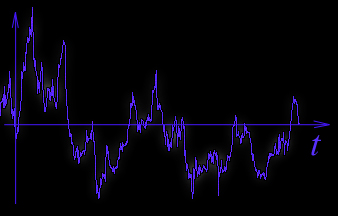
UponDescribed in these pages is an artificial intelligence, a learning algorithm, that is used to find patterns within a time series. The acquired time series is a measurable quantity, a collection of data points that vary over time. Collected from the wild it can represent almost anything that changes in time, such as: the count of sunspots, the number of hot dogs sold at a street corner per day, the weekly price of aluminum, etc. The time series to be analyzed is labeled: the output.
The output time series is considered to have been generated at the back end of an unknown, unviewable system. Examples of an unviewable system could be something like the climate, the atmosphere, the internal workings of the sun, the economy at large, etc. Generally it is some natural physical process that is difficult to observe or measure, where everything that controls it is not immediately viewable. This hidden system we label: the black box. At the front end of the black box enter the unknowable and unmeasurable forces and variables. These we label the input. Combining the input with the inner workings of the black box produces the collected, and measurable output. This output is the given time series we wish to analyze.
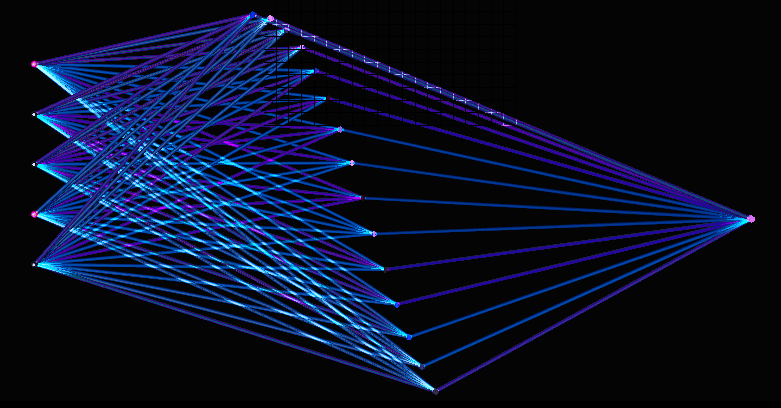
The algorithm tries to reproduce the unknown mechanisms of the black box by searching for the hidden patterns in the output time series. Thus, it tries to recreate the complex obscure system that initially produced the output time series. Once an approximate model for the black box is found, it can be used to predict future patterns of the output time series. This is accomplished by shifting internal parameters of the black box into the future. The derived black box consists of a feed-forward neural network. It is trained using a back propagation algorithm, enveloped within a genetic algorithm. A random noise generator with a variety of distributions are employed throughout the architecture of the network. Below is a diagram of a single neural network. It consists of input neurons, shown as the five objects on the left, hidden neurons, the middle connected objects, and a single output neuron, the single object to the far right. The connecting lines represent possible pathways for information flow connecting each individual neuron.
Techniques from time series analysis and global optimization are used to help the algorithm arrive at a stable solution for the best neural network, which ultimately produces the resulting prediction. For example, applications in time series analysis suggest that the information about the unknown black box model and its input signals are embedded in the output signal. The algorithm's analysis of the output signal is used to solve for the unknown properties of the black box and input signal. Problems of parroting are solved in a unique manner, allowing the neural nets to settle upon useful solutions. The A.I. is capable of analyzing time-dependent data, such as the price of raw materials, the price of stocks, or the magnitude of any pertinent sequential data, for the purposes of forecasting future patterns. Below are further descriptions of the inner workings of this A.I., along with some examples of its past performance. |

 |
 |
 |
| Prediction Results | The Artificial Intelligence | Background |
| example output predictions | faq | current projects |
| current work list | system specifications | previous projects |
| forums | proposed a.i. applications | custom machines |
| how to | ||
| link list | ||
| miscellaneous | ||
| sitemap | ||
| contact |
 |
dark maelstrom flash games |
 |
dark maelstrom t-shirt designs |
innerplanes | ai daemon project |  |